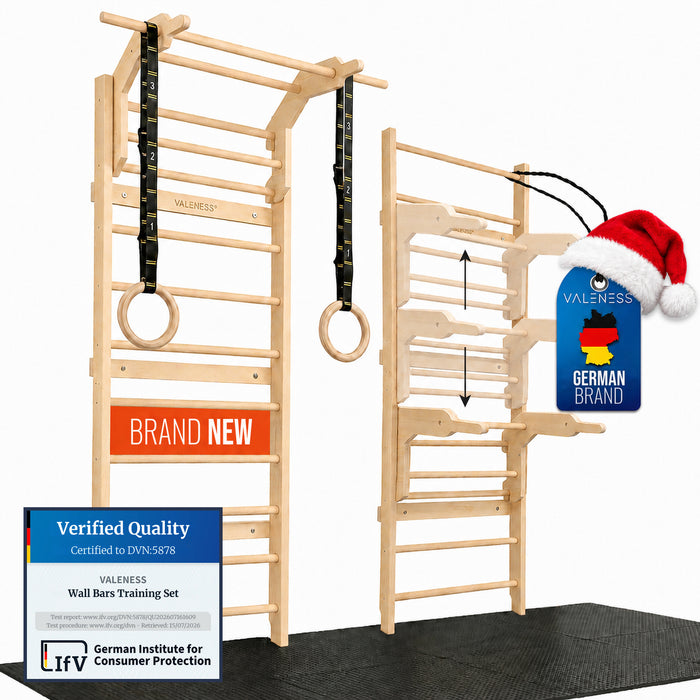
Wall bars in a rented flat: Am I allowed to drill, and which wall can take the load?
Sebastian Funke, Inhaber von VALENESS

If you rent, you will probably ask yourself two questions before buying wall bars: am I allowed to drill for them at all? And can my wall take it? The first is usually answered quickly. The second decides whether the wall bars will hang safely in your home.
This guide explains what you should bear in mind as a tenant when drilling, how to identify your wall without a professional, which wall in your flat is suitable and what to do when you move out.
Good to know: The information on tenancy law and cable routing in this article refers to Germany. Other rules apply in other countries, so check your tenancy agreement or ask a local tenants' association. The advice on walls and fixings applies everywhere.
The short answer
- Drilling: According to established case law, a normal number of wall plug holes counts as ordinary use of a rented flat. The VALENESS wall bars need six holes with a diameter of 10 mm.
- Wall: With the fixings supplied, concrete, solid brick, solid sand-lime brick and perforated sand-lime brick are suitable. Aerated concrete, vertically perforated brick and drywall need separate fixings, and you will have to check their load-bearing capacity yourself.
- Identifying: A knock test and the colour of the drilling dust reveal the wall material within a few minutes.
- Moving out: Pull out the wall plugs, fill the holes, paint over them. With six holes, this takes half an hour.
Are you allowed to drill in a rented flat?
As a rule, yes. Tenants' associations and many courts regard a normal number of drill and wall plug holes as use of the flat in accordance with the tenancy agreement. If you put up shelves, lamps or wall cupboards, you normally do not need permission. Six drill holes for wall bars are no more than a large wall shelf needs.
You should still do two things:
- Read your tenancy agreement. Some agreements contain rules on drilling or on handing back the flat. You should know them before you start.
- Check briefly with the property management. Not for permission, but because landlords and property managers often know what the walls are made of. That saves you the guesswork.
Which wall can hold wall bars
When you do pull-ups, more than your body weight is at work. Jumping up, hanging on and braking create brief force peaks. And because the attachment with the pull-up bar projects 71 cm into the room, the upper screws pull on the wall with a leverage effect. What matters, therefore, is how much a single wall plug holds in the wall material in question.
The VALENESS wall bars are supplied with six fischer DuoPower 10 × 80 wall plugs and matching screws. For this plug, the manufacturer fischer gives the following recommended loads:
| Wall material | Recommended load per wall plug | With the fixings supplied |
|---|---|---|
| Concrete | 4.20 kN, approx. 430 kg | suitable |
| Solid sand-lime brick | 3.85 kN, approx. 390 kg | suitable |
| Perforated sand-lime brick | 2.00 kN, approx. 200 kg | suitable |
| Solid brick | 1.45 kN, approx. 150 kg | suitable |
| Aerated concrete | 0.30 to 1.10 kN, approx. 30 to 110 kg | not suitable, separate fixings required |
| Vertically perforated brick | 0.40 kN, approx. 40 kg | not suitable, separate fixings required |
| Plasterboard, drywall | no manufacturer specification | not suitable, separate fixings required |
The values include the safety factor required by fischer and apply to wood screws with a diameter of 8 mm. 1 kN corresponds to roughly 100 kg of weight force.
Aerated concrete and vertically perforated brick hold considerably less with the wall plugs supplied. With aerated concrete, there is the added problem that its strength class cannot be identified from the outside.
Drywall, meaning plasterboard and stud walls, has no manufacturer specification at all for this wall plug. The boards are not made for the tensile and leverage forces of wall bars with a pull-up bar.
For all three wall types, the following applies: the fixings supplied are not sufficient. You need separate fixings, which are not included. Which ones these are and whether your wall can take the load is something you need to establish yourself or with a specialist firm.
How to identify your wall in five minutes
1. Knock test. Knock on the wall with your knuckle in several places. If it sounds hollow and gives slightly, it is almost always drywall. In that case the fixings supplied are not sufficient, and you need separate fixings. Solid walls sound dull and firm.
2. Test drilling at one of the final drilling points. Mark the six drill holes as shown in the instructions and drill only one of them first. That way, you do not create an additional hole. The drilling dust and resistance tell you the material:
| What you see and feel when drilling | Wall material |
|---|---|
| grey drilling dust, very hard, even resistance | Concrete |
| white drilling dust, hard, even resistance | Solid sand-lime brick |
| white drilling dust, the drill bit drops away at intervals | Perforated sand-lime brick |
| red drilling dust, even resistance | Solid brick |
| red drilling dust, the drill bit drops away at intervals | Vertically perforated brick |
| white to light grey, fine dust, the drill bit glides through with almost no resistance | Aerated concrete |
| white plaster dust, a cavity after 1 to 2 cm | Drywall |
Drill with a 10 mm masonry drill bit, at least 90 mm deep. If the drill bit drops away, switch off the hammer action. That way the webs in perforated brick do not break out and the wall plug gets a firm hold. Then vacuum or blow the drilling dust thoroughly out of the hole.
3. If in doubt, ask. In older buildings you will sometimes find clay, gypsum planks or cinder blocks. The wall plugs supplied are not designed for these either. If the drilling pattern is not clear, the property management can help.
Which wall in your flat is suitable
- External walls are solid. Whether they are suitable still depends on the material: in new builds they are often built from vertically perforated brick or aerated concrete because these insulate well. So check here too before you start.
- Walls to the neighbouring flat are usually solid for sound insulation, often made of concrete or sand-lime brick. Even so, they are not a good choice: pull-ups and gymnastic rings knocking against the wall can be transmitted as structure-borne noise, and your neighbours will then be training along with you acoustically.
- Internal walls within the flat are often drywall or aerated concrete in new builds, in which case separate fixings are required. Load-bearing internal walls, on the other hand, are solid and often well suited.
Two points that tenants will particularly appreciate: the skirting board does not have to come off. The wall bars stand about 2 cm away from the wall and have a recess at the bottom, so skirting boards up to 10 cm high and 2 cm deep fit underneath. And the wall bars stand on the floor, so the wall does not have to carry the entire weight on its own. Allow for a ceiling height of at least 240 cm and about 1.5 m of free space in front of the wall.
Cables: where you should not drill
In newer buildings, electrical cables run in defined installation zones in accordance with DIN 18015-3:
- horizontally about 15 to 45 cm below the ceiling and 15 to 45 cm above the floor
- vertically about 10 to 30 cm beside doors, windows and room corners
- vertically above and below sockets and switches
In older buildings you cannot rely on this. A cable detector from a DIY store costs little and should be held against the wall before every drilling. Also watch out for water and heating pipes, especially near radiators, the bathroom and the kitchen.
When moving out: how to keep your deposit intact
Courts take different views on whether tenants have to fill wall plug holes when they move out. In 2001, the Regional Court of Hamburg ruled that normal wall plug holes do not have to be removed without an express agreement (case no. 307 S 50/01). In 2020, by contrast, the Regional Court of Wuppertal upheld an obligation to fill them professionally, even without a valid renovation clause. That case, however, involved around 126 holes (case no. 9 S 18/20). If your tenancy agreement contains a valid clause on cosmetic repairs, filling the holes is generally part of it anyway.
With six holes, there is no point in arguing. Here is how to do it:
- Turn a screw a few turns into the wall plug and pull the plug out with pliers.
- Fill the hole with filler, smooth it off and leave it to dry.
- Sand lightly and paint over it in the wall colour.
If you move house, you simply take the wall bars with you. In your new flat you will need six new wall plugs of the same type, fischer DuoPower 10 × 80, which are available from DIY stores.
What the VALENESS wall bars offer tenants
| Feature | Details |
|---|---|
| Fixing | 6 fischer DuoPower 10 × 80 wall plugs with matching screws included |
| Drill holes | 6, 10 mm diameter, at least 90 mm deep |
| Suitable for | Concrete, solid brick, solid sand-lime brick, perforated sand-lime brick |
| Other walls | Aerated concrete, vertically perforated brick, drywall only with separate fixings, not included |
| Installation | free-standing on the floor, about 2 cm from the wall |
| Skirting board | up to 10 cm high and 2 cm deep, does not have to come off |
| Ceiling height | from 240 cm for the highest position of the pull-up bar |
| Dimensions | 225 × 80 cm, depth with attachment 71 cm, pull-up bar 115 cm long |
| Load capacity | up to 150 kg |
| Assembly | approx. 45 minutes, with assembly video |
| Price | €239,99 |
What you can train on the fully assembled wall bars is shown in the article Wall bars for adults: 8 exercises and a training plan. What else matters when buying is covered in the guide to wall bars for the home.
To be honest, when they are not the right fit: if you do not want to drill, have no suitable wall available or do not want to sort out separate fixings yourself for drywall, wall-mounted wall bars are the wrong choice. In that case, a free-standing pull-up station is the better solution. It does not require drilling, but it does need more floor space.
Frequently asked questions
As a tenant, am I allowed to fix wall bars to the wall with wall plugs?
As a rule, yes. A normal number of wall plug holes is considered use of the flat in accordance with the tenancy agreement. The VALENESS wall bars need six drill holes. Still, check your tenancy agreement to see whether it contains its own rules on drilling.
Do I need my landlord's permission?
Not normally for ordinary wall plug holes. A short message to the property management is still worthwhile, as they often know what the walls are made of.
Can they be assembled without large holes in the wall?
Yes. There are six holes with a diameter of 10 mm, similar to a heavy wall shelf. When you move out, they can be filled in a few minutes.
Can I fix wall bars to a plasterboard wall?
Not with the fixings supplied. On drywall you need separate fixings, which are not included. Which ones these are and whether the wall can take the load is something you need to establish yourself or with a specialist firm.
Which wall plugs do I need for a concrete wall?
The VALENESS wall bars come with six fischer DuoPower 10 × 80 wall plugs and matching screws. In concrete, fischer recommends a load of 4.20 kN per plug for this type, approx. 430 kg. Drill with a 10 mm masonry drill bit, at least 90 mm deep.
Will the wall bars hold on a brick wall?
On solid brick, yes. In vertically perforated brick, the wall plug supplied holds only approx. 40 kg, so separate fixings are required there. Red drilling dust and a drill bit that drops away at intervals indicate vertically perforated brick.
Do I have to fill the holes when I move out?
That depends on the tenancy agreement and the individual case, as courts rule differently on this. With six holes, filling them is quicker than any argument about the deposit.
Can I take the wall bars with me when I move?
Yes. Unscrew them, pull out the wall plugs, fill the holes. In your new flat you install them with six new fischer DuoPower 10 × 80 wall plugs.
Does the skirting board have to come off?
No. Skirting boards up to 10 cm high and 2 cm deep fit under the recess in the side panels.
Last updated: October 2026. Prices include VAT. The information on tenancy law reflects established case law; in individual cases, the tenancy agreement and the court decide.