Wall bars for adults: 8 exercises and a training plan for home
Sebastian Funke, Inhaber von VALENESS

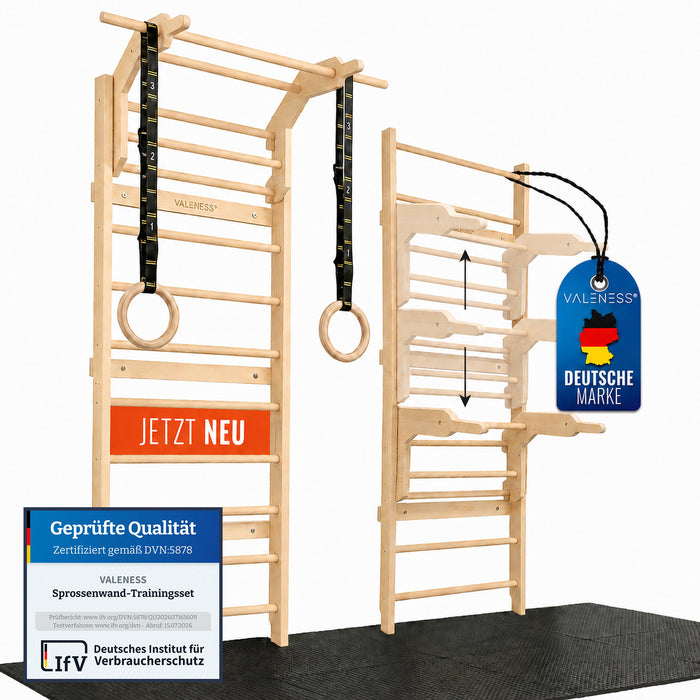
For children, wall bars are a climbing frame. For adults, they are a small gym on 80 cm of wall width. With a pull-up bar, dip station and gymnastic rings, you can train your back, arms, chest and core on them, and with one simple trick your legs as well.
What most people lack is not the equipment but a plan. Here it is: eight exercises, ordered from first steps to the pull-up, and three training plans for beginners, advanced users and anyone who mainly spends a lot of time sitting.
The eight exercises at a glance
| Exercise | Works | Level | Where on the wall |
|---|---|---|---|
| Active hang | Grip strength, shoulders | Beginner | Pull-up bar |
| Ring rows | Back, biceps | Beginner | Gymnastic rings |
| Negative pull-up | Back, biceps | Beginner to intermediate | Pull-up bar |
| Pull-up | Back, biceps, core | Advanced | Pull-up bar |
| Dips | Chest, triceps, shoulders | Intermediate | Dip station |
| Hanging knee and leg raises | Abs, hip flexors | Intermediate | top rung |
| Push-ups on the rungs | Chest, shoulders, triceps | Beginner to intermediate | lower rungs |
| Bulgarian split squat | Legs, glutes | Beginner to intermediate | lower rung |
Before you start: what the wall has to withstand
Pull-ups put more than your body weight on the wall. Every jump up, hang and braking movement creates short force peaks. Then there is leverage: the pull-up bar projects up to 115 cm into the room, and the further forward you hang, the harder the upper screws pull on the wall.
This leads to four rules:
- Load-bearing wall, all drill holes. Concrete and solid brick are ideal. Which wall holds what is explained in detail in the guide to wall bars at home.
- Controlled, not with momentum. Kipping pull-ups put considerably more strain on the anchoring and your shoulders. At home, you train cleanly and slowly.
- A weight vest counts too. The load limit applies to everything hanging on the wall, so body weight plus additional weight.
- Retighten. Check all screws once after the first few weeks of training, then at regular intervals.
On height: Set the pull-up bar so that about 30 cm of space remains above it to the ceiling, otherwise you will hit your head at the top. Taller people can almost reach the floor with straight arms at a wall height of 2.25 m. In that case, you do pull-ups with your knees bent. This is normal on wall bars and makes no difference to the exercise.
The eight exercises
1. Active hang
Hang from the pull-up bar with straight arms. Then pull your shoulder blades down without bending your arms. Your body rises only a few centimetres. Hold for 20 to 30 seconds.
It looks unspectacular, but it is the foundation of every pull-up: it trains grip strength and control over your shoulders.
2. Ring rows
Set the gymnastic rings to hip height. Grip the rings and lean back with your body straight, keeping your heels on the floor. Now pull your chest towards the rings and lower yourself back in a controlled way.
You adjust the difficulty through the angle: the flatter you lie, the harder it gets. Ring rows build exactly the strength you will later need for the pull-up.
3. Negative pull-up
Climb up the rungs until your chin is above the bar. Then take your feet away and lower yourself slowly over three to five seconds. Climb back up for the next repetition.
For many people, this is the most effective route to their first pull-up, because the muscle can handle more load when lowering than when pulling up. The rungs take the place of a stepladder.
4. Pull-up
From the active hang, pull your chest towards the bar until your chin is above it. Lower yourself in a controlled way until your arms are almost straight. Grip shoulder-width apart or slightly wider.
Easier: With an underhand grip, palms facing you, the biceps do more of the work. A resistance band on the bar takes off additional weight. Harder: lower more slowly, hold for one second at the top, later add a weight vest.
5. Dips
Set the module to the dip position. Support yourself with straight arms, lean your upper body slightly forward and lower yourself until your upper arms are roughly horizontal. Then push back up.
You should not go lower than horizontal, as this puts unnecessary strain on your shoulders. Easier: hold the support position for 20 seconds or only lower slowly.
6. Hanging knee and leg raises
Hang from the top rung with your back to the wall. Pull your knees towards your chest in a controlled way, tilting your pelvis slightly. Return slowly.
The rungs behind you stop you from swinging. That is exactly what makes the exercise so effective on wall bars. Harder: with straight legs.
7. Push-ups on the rungs
This exercise can be adjusted in both directions. Easier: hands on a rung at hip height, body at an angle, which makes the push-up considerably easier. Harder: feet on the second or third rung, hands on the floor. The higher your feet, the more your shoulders and upper chest work.
8. Bulgarian split squat
Stand with your back to the wall, about one large step away. Place the top of one foot on a rung at knee height. Now bend your front leg until your thigh is roughly horizontal, and push yourself back up. Keep your knee over your foot.
Here the rung takes the place of a weight bench. The exercise is demanding even without additional weight, because one leg carries almost your entire body weight.
Three training plans
How to progress: Once you can manage the top end of the repetition range cleanly in all sets, move on to the harder variation. Rest 60 to 90 seconds between sets.
Beginner: twice a week, about 25 minutes
With at least one rest day in between, for example Monday and Thursday.
| Exercise | Sets × reps |
|---|---|
| Active hang | 3 × 20 seconds |
| Ring rows | 3 × 8 to 12 |
| Negative pull-up | 3 × 3 to 5, lowering over 4 seconds each |
| Push-ups, hands on the rung | 3 × 8 to 12 |
| Bulgarian split squat | 2 × 8 per leg |
| Hanging knee raises | 3 × 6 to 10 |
Advanced: three times a week, about 35 minutes
Alternate day A and day B, so A, B, A one week and B, A, B the next.
| Day A | Sets × reps |
|---|---|
| Pull-up | 4 × 4 to 8 |
| Dips | 3 × 6 to 10 |
| Bulgarian split squat | 3 × 10 per leg |
| Leg raises, legs straight | 3 × 8 to 12 |
| Day B | Sets × reps |
|---|---|
| Underhand pull-up | 3 × 5 to 8 |
| Ring rows, flat angle | 3 × 10 to 15 |
| Push-ups, feet elevated | 3 × 10 to 15 |
| Active hang | 2 × 30 to 45 seconds |
For anyone who sits a lot: 10 minutes a day
Not strength training, but a counterbalance to the desk.
| Exercise | Duration |
|---|---|
| Relaxed hang, feet on the floor if needed | 3 × 20 to 30 seconds |
| Hip flexors: deep lunge, hands on a rung | 2 × 30 seconds per side |
| Backs of the legs: heel on a rung at hip height, lean your upright upper body forward | 2 × 30 seconds per side |
| Chest and shoulder: side-on to the wall, hand on a rung at shoulder height, turn your upper body away | 2 × 30 seconds per side |
Many people find hanging in particular soothing after a long working day. If you have back or shoulder problems, discuss the training with your doctor or physiotherapist first.
What the VALENESS wall bars offer for this
| Feature | Details |
|---|---|
| Dimensions | 225 × 80 cm, projection with pull-up bar 115 cm |
| Rungs | 10, solid beech, Ø 3 cm, 22.5 cm spacing |
| Load capacity | up to 150 kg |
| Pull-up bar | height-adjustable, main bar removable |
| Dip station | included in the 2-in-1 module |
| Gymnastic rings | 2, 17 cm diameter, straps adjustable up to 3.5 m |
| Mounting | Fischer wall plugs and screws, six drill holes |
| Testing | DVN:5878 (German Institute for Consumer Protection, IfV) |
| Assembly | approx. 45 minutes, with video instructions |
| Price | €239,99 |
All eight exercises work with them without any further accessories. Resistance bands and suspension trainers can also be attached. View the VALENESS wall bars
On rest days, the only thing missing from the plan is cardio. If you would rather not go outside for it, the VALENESS walking pad is the space-saving addition: just 13 cm high and easy to store under a bed or sofa.
To be honest, where they are not the right fit: Wall bars do not replace a squat rack. Heavy leg training with a barbell is not possible on them; you train your legs with your own body weight. If you exceed 150 kg with a weight vest, or only have a plasterboard wall without a supporting frame, you should look for a different solution.
Frequently asked questions
Are wall bars enough to build muscle?
For the upper body and core, yes. Pull-ups, dips and leg raises are among the most effective bodyweight exercises. You progress through leverage, tempo, repetitions and later additional weight. For the legs, they are enough for solid basic strength, but not for heavy strength training.
How often should I train?
Two to three times a week with at least one rest day in between. You can do the stretching exercises every day.
I can't do a pull-up yet. Where do I start?
With active hangs, ring rows and negative pull-ups, as in the beginner plan. How quickly the first pull-up comes varies a great deal. If you keep at it twice a week, you will usually notice progress within a few weeks.
Can wall bars withstand pull-ups and dips by adults?
Yes, if they are designed for it and correctly installed. The VALENESS wall bars have a load capacity of up to 150 kg and are anchored to a load-bearing wall with Fischer wall plugs. The wall is what matters, not just the equipment.
Can I train with a weight vest?
Yes, as long as your body weight and the vest together stay below 150 kg.
How high should the pull-up bar be?
High enough that about 30 cm of space remains above the bar to the ceiling. With low ceilings, it is better to go one rung lower and bend your knees instead.
Wall bars or a power rack?
If you mainly train with your own body weight and have little space, wall bars are the better choice: 80 cm of wall width instead of a freestanding frame. If you want to train heavy with a barbell, you need a rack.
Last updated: October 2026. Prices include VAT.