Wall bars for the home 2026: guide and buying advice
Sebastian Funke, Inhaber von VALENESS

Wall bars are one of the most versatile pieces of training equipment for the home: pull-ups, dips, leg raises, traversing and back exercises are all possible with a single, space-saving unit. At the same time, wall bars work as a climbing wall for a child's room and support motor skills and coordination. This guide explains what matters when buying wall bars in 2026 – from the condition of the wall to the right additional equipment.
What to look for when buying wall bars
The condition of the wall is decisive
The most important question before buying is not the wall bars themselves, but the wall they are to be mounted on. On load-bearing walls made of concrete or solid sand-lime brick, a floating installation is usually possible. With other wall types – such as plasterboard or timber stud walls – additional floor-standing support is generally recommended so that the wall bars stand stably and safely.
Load capacity
For strength training with pull-ups and dips, wall bars should carry at least 120–150 kg. If the wall bars are also used by children for climbing, tested stability in this range is equally important.
Material
Wall bars made of beech offer a good combination of stability, durability and pleasant feel. Beech is a hard, hard-wearing wood that is suitable for long-term use in a home gym or a child's room.
Additional equipment
A pull-up bar considerably expands the training options. A dip station additionally allows chest and triceps exercises. Gymnastic rings enable further variations such as ring dips or traversing exercises. If you also want to use TRX or resistance bands, check compatibility.
Fixing material
High-quality fixing material is not a detail on wall bars, it is safety-relevant. Branded wall plugs and matching screws – from Fischer, for example – ensure a secure hold in the wall.
Wall types: where wall bars hold and where they do not
Wall bars are only as safe as the wall they hang on. A pull-up with momentum briefly generates a multiple of your body weight as tensile force – which is why it is worth clarifying the wall construction beforehand rather than afterwards.
Concrete and solid sand-lime brick
The straightforward case. Both materials have a high load capacity, and ordinary branded wall plugs in the right diameter hold securely. Here, floating wall installation without floor support is possible. Drilling into concrete calls for a rotary hammer; percussion drilling takes unnecessarily long.
Vertically perforated brick and aerated concrete
This is where it gets tricky. Both types of block are hollow inside or soft, and normal expansion plugs find little resistance. Special plugs are required: injection mortar with a sieve sleeve for vertically perforated brick, special aerated concrete plugs for Ytong. Drilling without the hammer action is essential, otherwise the hole breaks out.
Plasterboard and timber stud walls
Wall bars never belong in the boarding itself – the panel tears out. Two approaches work: screwing directly into the studs of the substructure, whose position can be located with a cable and stud detector, or a version with floor-standing support, in which the wall only secures against tipping and the load rests on the floor. If in doubt, the supported version is the right choice.
Older buildings with clay or pumice hollow block
No general statement is possible here. A test hole in an inconspicuous spot quickly shows what you are dealing with. If you are unsure, call in a tradesperson – the cost of an hour bears no relation to the risk of wall bars tearing out of the wall.
Assembly step by step
With the tools prepared, assembly takes about 45 minutes. The procedure:
- Determine the position. The top rung should sit high enough for your legs to hang free during pull-ups – with a room height of 2.50 m, a 225 cm high unit fits with a little clearance to the ceiling. Check wall edges, sockets and heating pipes beforehand.
- Mark the drill holes. Set the unit up, align it with a spirit level and mark through the existing holes. This is considerably easier with two people.
- Drill. Diameter and depth according to the plug specification. Blow out the drilling dust thoroughly – it is the most common reason for plugs that do not grip properly.
- Fix in place. First set all screws loosely, then tighten them crosswise. That way the frame does not become distorted.
- Check. Hang from the top rung with your full body weight and swing gently. What withstands that will withstand training.
The screws should be retightened after four weeks and every six months thereafter. Wood moves, and plugs settle.
What you can train on wall bars
Versatility is the real argument. An overview by training goal:
Back and arms
Pull-ups with an overhand and underhand grip, in various grip widths and, with the help of a band, for beginners too. Plus sideways traversing, rows with the body at an angle and lat pulldown variations with a resistance band.
Core
Hanging leg raises are the most effective exercise wall bars offer – straight and to the side, with bent or straight legs depending on your level. Plus jackknives with the feet hooked in and rotation exercises while hanging.
Chest and triceps
With the dip station fitted, dips are added, the classic exercise for the lower chest. Press-ups with the feet raised on one of the lower rungs shift the load upwards into the shoulders.
Mobility and stretching
The most underrated part. The rungs serve as a height grid for hip flexor, hamstring and shoulder stretches, and simply hanging with your full body weight noticeably relieves the spine – for anyone who works sitting down, often the main reason for the purchase.
You will find eight exercises and three ready-made training plans in the article Wall bars for adults: 8 exercises and a training plan for home.
Wall bars in a child's room
For children, wall bars are above all a climbing frame, and that is their greatest benefit: climbing trains coordination, strength and body awareness better than most indoor play equipment.
Three points belong with this. First, a soft surface – a gym mat or a thick rug in front of the unit. Second, a clear rule on supervision: toddlers only climb under supervision, school-age children usually no longer need it. Third, regular checks of the screw fixings, because children load the unit differently from adults – with momentum and sideways.
It is practical that the same unit grows with them: what is a climbing frame at four becomes a pull-up bar at twelve.
Assessing the space required correctly
The footprint is small, the movement space is not. Wall bars 80 cm wide need hardly any space on the wall, but around one metre should remain free in front – during leg raises and traversing the body swings. Around 20 cm of clearance to the ceiling makes sense so that the top rung can still be gripped.
With the pull-up bar fitted, projection is added: on the VALENESS unit this is 115 cm of depth. If you remove the bar, the unit is reduced to a good 20 cm again – practical in rooms that are also used for other purposes.
The VALENESS wall bars at a glance
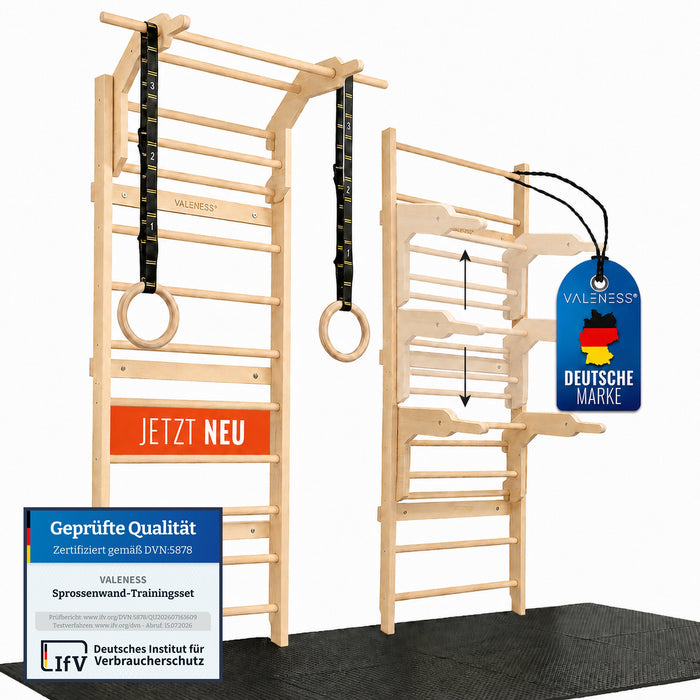
The VALENESS wall bars in solid beech combine strength training, mobility and calisthenics in one piece of equipment and are at the same time designed as a safe climbing wall for children – equipment for the whole family.
| Feature | Details |
|---|---|
| Dimensions | 225 × 80 × 115 cm (height × width × projection with pull-up bar) |
| Material | Solid beech, 10 rungs |
| Load capacity | up to 150 kg |
| Equipment | Height-adjustable pull-up bar, dip station, 2 height-adjustable gymnastic rings |
| Compatibility | TRX and resistance bands can be used |
| Assembly | Wall mounting, incl. Fischer DuoPower plugs (10 × 80 mm) and matching screws |
| Space required | 235 × 80 × 115 cm – allow 10 cm of clearance above the unit so that the top rung remains within reach |
| Suitable for | Adults and children |
| What's included | Wall bars, pull-up bar, dip station, 2 gymnastic rings, fixing material, assembly instructions |
| Certification | tested to DVN:5878 (German Institute for Consumer Protection, IfV) |
| Assembly time | approx. 45 minutes, only six drill holes, video instructions included |
| Price | €239,99 |
In short: the VALENESS wall bars are fully equipped for pull-ups, dips, leg raises, traversing and back exercises – without having to buy additional accessories.
Frequently asked questions about wall bars
Which wall is suitable for mounting wall bars?
On load-bearing walls made of concrete or solid sand-lime brick, floating wall installation is usually possible. With plasterboard or timber stud walls, additional floor-standing installation is generally recommended in order to ensure the necessary stability.
Are wall bars safe for children?
Yes, provided they have been mounted correctly and the load limits are observed. The VALENESS wall bars are designed for adults and children alike and serve as a climbing wall that supports motor skills, coordination and enjoyment of movement.
Which exercises are possible with wall bars?
With the pull-up bar, dip station and gymnastic rings, pull-ups, dips, leg raises, traversing and back exercises are possible, among others – and, with additional equipment, TRX and resistance band training as well.
How much space do wall bars need?
The VALENESS wall bars are 225 cm high and 80 cm wide; with the pull-up bar fitted they have a projection of 115 cm. For the space required, allow 235 × 80 × 115 cm – the 10 cm of clearance above ensures that the top rung remains within reach. This makes them comparatively space-saving and suitable for home gyms, children's rooms or smaller fitness rooms.
Which fixing material is needed?
High-quality branded fixing material from Fischer is included with the VALENESS wall bars – DuoPower plugs (10 × 80 mm) as well as matching screws for a secure fixing.
Do wall bars hold in a plasterboard wall?
Not in the boarding itself. Either they are screwed directly into the studs of the substructure – whose position a cable and stud detector will find – or a version with floor-standing support is used.
How high should the top rung be?
High enough for your legs to hang free during a pull-up. With a room height of 2.50 m, a 225 cm high unit fits well if around 20 cm of clearance remains at the top.
Which wood is the right one?
Beech is considerably harder than pine and does not splinter. Coated chipboard looks similar at first, but loses its shape under sustained load. For rungs that are gripped every day, solid beech is the most durable choice.
Does my child need a mat in front of it?
Yes. A gym mat or a thick rug in front of the unit is part of the set-up as soon as children climb. Toddlers should also be supervised.
How often do I have to retighten?
Once four weeks after assembly, then every six months. Wood moves with the room humidity, and plugs settle under load.