Basketball Stand Test 2026: The 4 Best Models Compared
Sebastian Funke, Inhaber von VALENESS

A mobile basketball stand brings the court to your own driveway or garden – no drilling, no fixed installation, and you can simply move it when needed. The differences between models are considerable, however: in height adjustment, stability and, above all, in what is included. We compared four popular basketball stands and rated them by height range, material quality, what's included and value for money.
How we rated
Four criteria, in order of everyday relevance:
- Height range: The minimum height above all. It determines the age from which a stand can be used at all – and in product descriptions it is almost always hidden behind the maximum height.
- Stability: Base volume, filling method and behaviour under lateral load.
- Material quality: Backboard material, bolt material and rim mounting – the three points that determine service life.
- What's included: Whether a ball, pump and spare net are supplied. Bought separately, that is 30 to 40 €, which shifts the price comparison.
Prices are guide values from August 2026 and vary depending on the retailer and current promotions.
The 4 models at a glance
| Model | Height range | Price (approx.) | What's included | Distinctive feature |
|---|---|---|---|---|
| VALENESS Profi | 135–305 cm | €189,99 | incl. basketball + pump | largest height range, stainless steel bolts |
| Spalding NBA Portable | 228–305 cm | from approx. 350 € | without ball | acrylic glass board, Helix Lift system |
| Hudora Competition Pro 305 | 230–305 cm | approx. 249–319 € | without ball | padded base |
| Yaheetech | 217–279 cm | approx. 100 € | without ball | affordable entry level |
The models in detail
1. VALENESS Profi – Best value for money
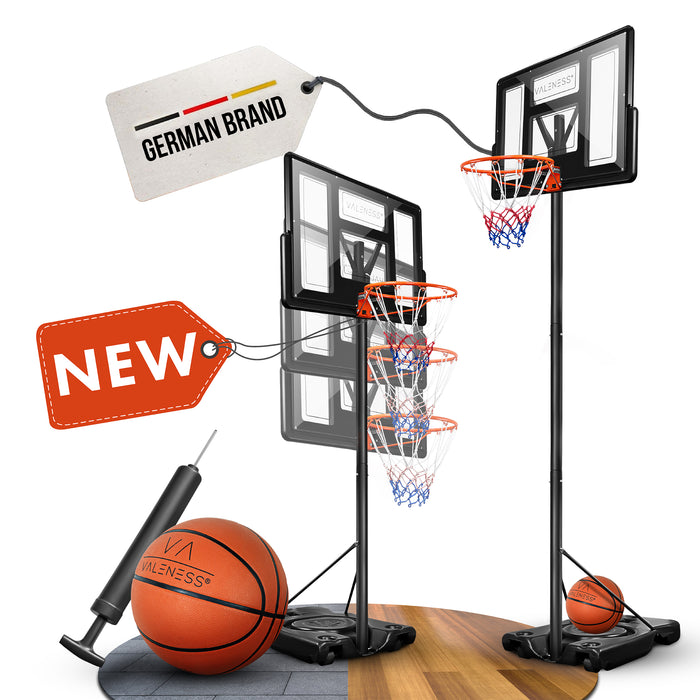
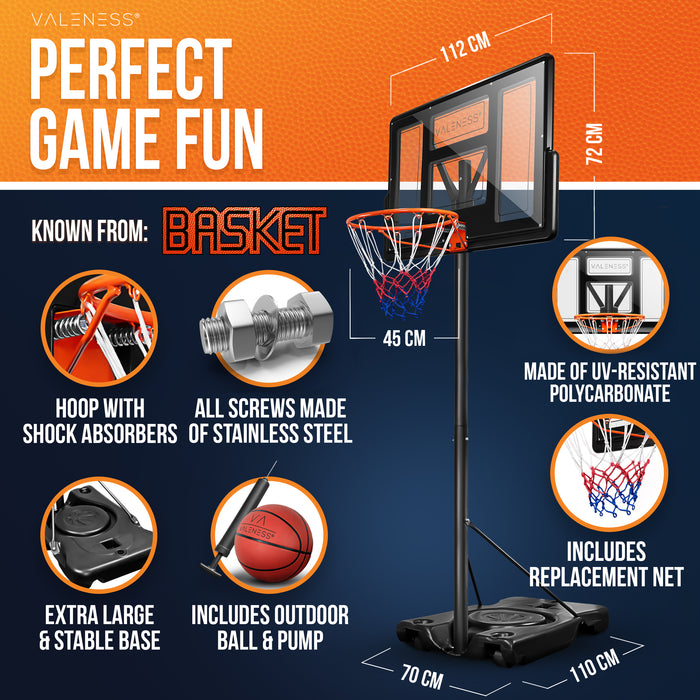
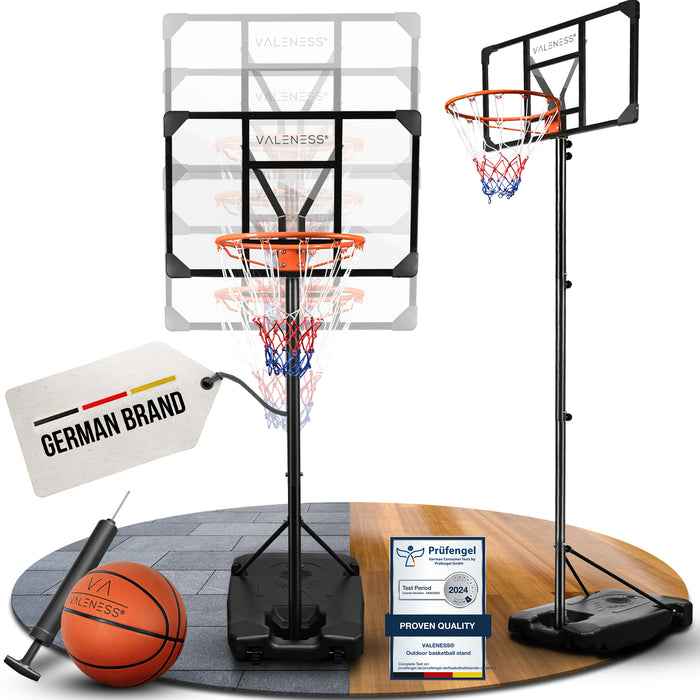
At 135 to 305 cm, the VALENESS Profi basketball stand covers by far the largest height range in this comparison. It therefore grows with you from primary school age up to the official competition height (3.05 m) – it is the only model in the test suitable for children, teenagers and adults alike.
For outdoor use the frame is coated and all bolts are made of stainless steel – a detail that is often missing on cheaper models and makes the difference after a winter outdoors. The base can be filled with up to 90 kg of sand or 70 l of water; for lasting stability we recommend sand — that is 20 kg more ballast than with a water filling.
A basketball and a pump are included – so you can play straight after assembly.
Advantages:
- Largest height range in the comparison (135–305 cm), incl. official competition height
- Basketball and pump included
- Stainless steel bolts and coated frame for year-round use
- Fair price for the equipment offered
Disadvantages:
- No acrylic glass board as in the premium segment
- Brand (still) less well known than Spalding or Hudora
2. Spalding NBA Portable – The premium choice
Spalding equips professional leagues, and you can tell with the NBA Portable: the board made of transparent acrylic glass offers rebound behaviour that comes close to permanently installed systems. The Helix Lift system with counterweight springs allows particularly convenient, precise height adjustment from 228 to 305 cm.
In return, Spalding charges the highest price in the comparison – and height adjustment only starts at 228 cm. This makes the model unsuitable for younger children. At 3–4 hours, assembly is the most demanding in the test.
Advantages:
- Acrylic glass board with very good rebound
- Convenient height adjustment via Helix Lift system
- Established professional brand with high build quality
Disadvantages:
- Highest price in the comparison
- Minimum height 228 cm – not suitable for younger children
- Long assembly (3–4 hours), ball not included
3. Hudora Competition Pro 305 – The familiar brand
The Hudora Competition Pro is height-adjustable in six steps from 230 to 305 cm. The welded, powder-coated steel frame stands on a base whose substructure is padded with foam – this reduces the risk of injury during lay-ups.
Customer reviews are mixed, however: alongside much praise for stability, some buyers report quality problems with the board and rim. As with Spalding, height adjustment only starts at 230 cm, and a ball is not included.
Advantages:
- Padded base for greater safety
- Solid steel construction, well-known brand
- Competition height of 305 cm achievable
Disadvantages:
- Height adjustment only from 230 cm
- Mixed customer reviews on build quality
- Ball and pump not included
4. Yaheetech – The affordable entry level
If you are looking for a first basketball stand for around 100 €, the Yaheetech model gives you a height-adjustable system from 217 to 279 cm with a fillable base and wheels for transport.
The limits show in the details: the maximum height of 279 cm remains well below competition height, the board is more simply made, and the construction is not designed for intensive play or hard shots on the rim.
Advantages:
- Lowest price in the comparison
- Wheels for easy transport
- Sufficient for occasional players
Disadvantages:
- Maximum height only 279 cm – no competition height
- Simpler material and build quality
- Ball and pump not included
Which basketball stand suits whom?
- Families with children who should be able to grow with it: VALENESS Profi – the only model adjustable from 135 cm and extendable up to competition height.
- Ambitious players with a large budget: Spalding NBA Portable – best board, but only for teenagers and adults.
- Brand-conscious buyers: Hudora Competition Pro 305 – solid, but without a ball and only from 230 cm.
- Occasional players on a small budget: Yaheetech – inexpensive, but with compromises in height and material.
Stability: what really matters
The most underestimated point. A mobile stand does not stand firm through its own weight, but through the filled base – and the interplay of volume, filling material and footprint determines whether it stays put during a dunk.
As a rule of thumb: the larger the footprint of the base, the more tip-resistant the stand at the same filling weight – the leverage then works for the stand instead of against it. Models with a narrow, tall base look compact but are more sensitive to lateral impacts.
On the filling material: sand provides about 1.5 kg per litre, water 1 kg. With a 40-litre base that is 60 as against 40 kg – a difference you notice immediately when playing. Water also has to be drained before frost, because ice expands and can damage the base.
Weather resistance in detail
All the stands compared here are built for outdoor use, but they age at different rates. Three components are decisive.
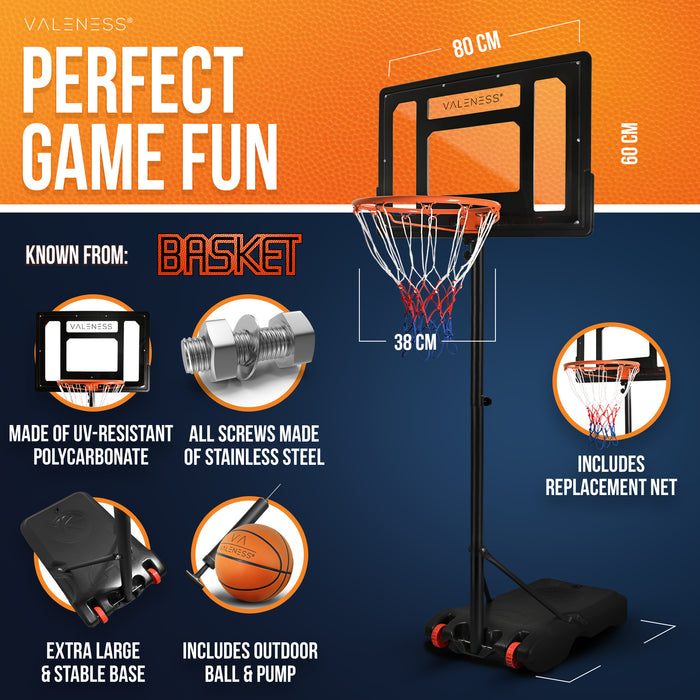
The backboard is the most visible point. Acrylic glass offers the best rebound behaviour, but yellows under UV radiation and can splinter in frost. Polycarbonate is more impact-resistant and ages better, but is somewhat less direct in rebound behaviour. For a hoop that stands outside all year round, polycarbonate is the more practical choice.
The bolts are the most inconspicuous and at the same time the most telling component. Stainless steel does not corrode. Galvanised steel does as soon as the zinc layer is damaged during tightening – and that is precisely when the height adjustment can no longer be moved after two years.
The rim mounting determines what happens when someone hangs on the rim. A rigid rim bends permanently, a sprung rim gives way and returns to its original position. Where children play, that is not a question of comfort.
Assembly compared
Assembly times differ considerably – from about 30 minutes to several hours for the premium models with spring mechanisms. The relationship here is not "more expensive equals easier": convenient height-adjustment systems are more complex to fit than a simple push-fit pole.
The following applies to all models: assemble with two people, set the bolts loosely at first and tighten them crosswise, then retighten after the first day of play. If you assemble the stand on your own, be particularly careful when raising the pole.
Which stand is worthwhile for whom
Families with younger children primarily need a low minimum height. Models that only start at 228 or 230 cm are ruled out here – regardless of their other qualities.
If you want to get long-term use out of it, look for the largest adjustment range. A stand that reaches from well below 200 cm up to 305 cm covers primary school age through to adulthood with a single unit.
Ambitious players for whom rebound behaviour matters and minimum height is irrelevant are best served by an acrylic glass board – at a corresponding surcharge.
Occasional players on a tight budget get a functioning stand for around 100 €, but should then expect neither accessories nor a particularly long service life.
Which VALENESS model suits which age?
The comparison above features the Profi model because it competes against the competition height of rival products. There are, however, three variants that differ solely in height range and board size – material, bolts and workmanship are identical.
| Model | Height range | Backboard | Base | Price |
|---|---|---|---|---|
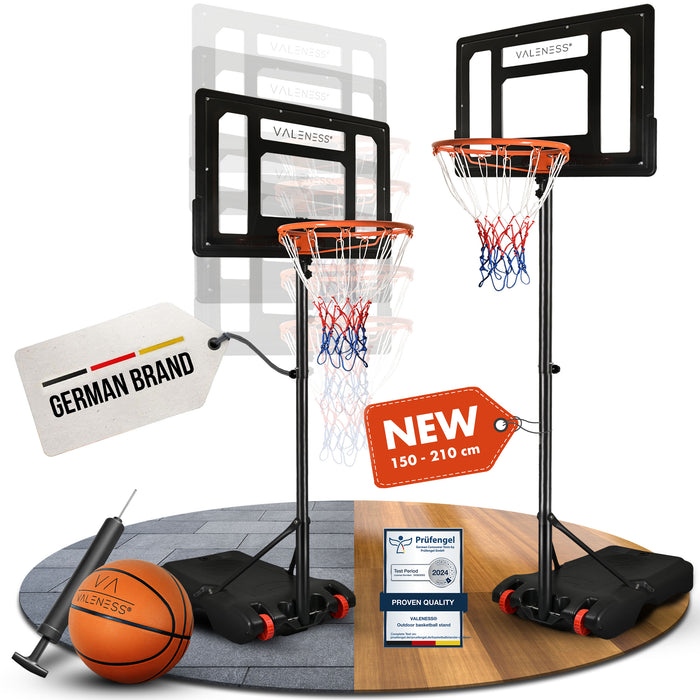
| Children | 150–210 cm | 80 × 60 cm | 45 kg sand / 31 l water | €79,99 |
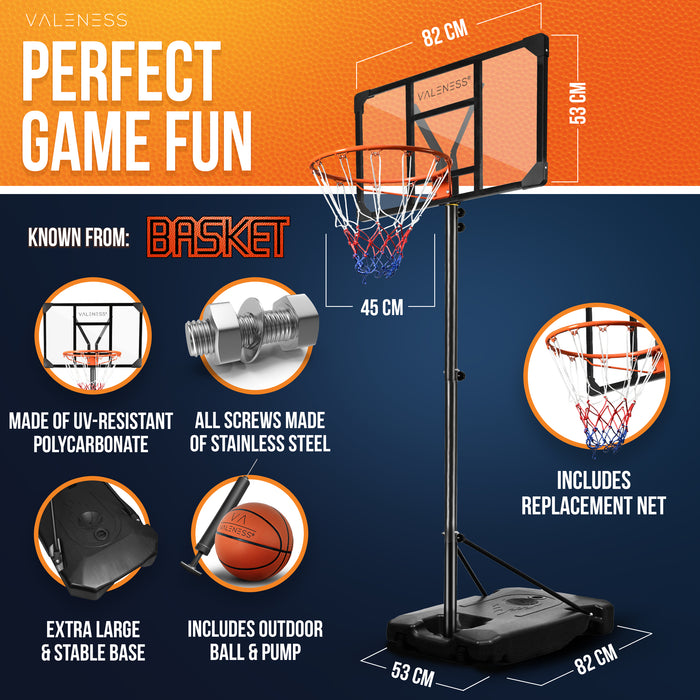
| Teenagers | 147–260 cm | 82 × 53 cm | 65 kg sand / 54 l water | €129,99 |
| Profi | 135–305 cm | 112 × 72 cm | 90 kg sand / 70 l water | €189,99 |
The minimum height is the more important figure here: at 135 cm the Profi model starts even lower than the children's model and is the only one to cover the entire range up to the official competition height. If you want to buy just one unit for the next ten years, choose this one. If you are buying for a child under ten and have an eye on the price, you are better off with the children's model.
Frequently asked questions (FAQ)
Which height is the right one?
For children aged 3–6, 150–170 cm is recommended, for primary school children aged 7–10 about 170–210 cm, for 10- to 16-year-olds 210–260 cm, and from 16 years the official height of 305 cm. You will find detailed recommendations in our buying guide for basketball stands.
Sand or water in the base?
Sand is the better choice: it is heavier, does not evaporate and cannot freeze in winter. Water is only suitable for temporary use in summer.
Can the basketball stand stay outside in winter?
Yes, provided the frame and bolts are protected against rust – on the VALENESS Profi this is ensured by the stainless steel bolts and the coated frame. If filled with water, the base must be emptied before the first frost.
How long does assembly take?
1–4 hours depending on the model. With two people it is considerably quicker, particularly when raising the pole and fitting the board.
What minimum height do I need for primary school children?
About 150 to 210 cm. Stands that only start at 228 cm cannot sensibly be used by this age group – no matter how high they reach.
Acrylic glass or polycarbonate?
Acrylic glass has the better rebound behaviour, polycarbonate the greater resistance to ageing and impact. For a stand that stays outside all year round, polycarbonate is the more practical choice.
How much filling weight does the base need?
As much as the instructions specify – and in full. A half-filled base is the most common reason for mobile stands tipping over. On the VALENESS Profi it is up to 90 kg of sand or 70 l of water, on the teenagers' model 65 kg or 54 l, and on the children's model 45 kg or 31 l.
Can I assemble the stand on my own?
Possible yes, advisable no. Especially when raising the pole and aligning the backboard, a second person is less a matter of comfort than of safety.
As at: August 2026. Prices are guide values and may vary depending on the retailer.